Building Think Club
What's been
bugging you?
Good company for the big questions, and the small ones.
thinkclub.devIs it ever right to get even?
Think Club is a place to bring a question that's been bugging you and think it through in good company: history's great thinkers, grounded in their texts, with citations. You ask Kant whether it's ever okay to lie. You ask Socrates whether it's ever right to get even. You put three of them in a debate and moderate. I started building it on November 6.
That box is the homepage. The site is about the thinking. This is the other half: a smattering of how it works, and what it takes to keep an Echo faithful to the thinker, in voice and cited.
What an Echo is
The thinkers on Think Club are Echoes: AI reconstructions built only from a thinker's published writing (and recorded talks) in our library. An Echo speaks in the first person, in the thinker's voice, and knows it's a copy, not the person. Every reply carries the Echo label, so even a screenshot says what it is. Living thinkers get a line saying they're alive and aren't involved with Think Club.
An Echo isn't a chatbot doing an impression. It has rules:
- Cite or flag. Every substantive claim points to a passage in the library. Anything past the thinker's writing is marked as extrapolation.
- No invented quotations. Quotation marks only go around text that exists word for word in the library.
- Keep the method, not just the voice. Socrates asks questions. Seneca writes letters to a friend.
- Know the limits. It isn't therapy: a crisis check pauses the Echo and points to real support. And it won't tell you who to vote for.
AI is the gear. Thinking is the sport.
That's the stance under all of it. The point of a session is what you leave believing and why, not what the model said.
The machinery
Every reply runs the same path: a safety check, research, a prompt, the model, and a grounding check on the way out.
Research. A small planning call picks up to three searches: the topic itself, a related idea of the thinker's, and an objection. Each search is hybrid, keyword and vector, fused by rank, and the best eight passages go to the Echo. On November 19, the library held 13,788 passages.
The prompt. The system prompt holds who the thinker is, how they argue, what they'd never say, and the citation rules. It stays the same from turn to turn, so it caches. The passages ride along with your message, and the model cites them with markers that point at passage IDs.
The grounding check. This is the part I trust most, because it doesn't trust the model. A citation that points at a passage the model wasn't given, or that shares too little with its sentence, gets dropped. A substantive sentence with no citation gets marked as extrapolation. A quotation that isn't in the library word for word loses its quotation marks: the paraphrase stays, the false quote goes. It's a lexical check, cheap and fast. Whether a passage actually supports a sentence is a judgment call, and that's what the evals are for.
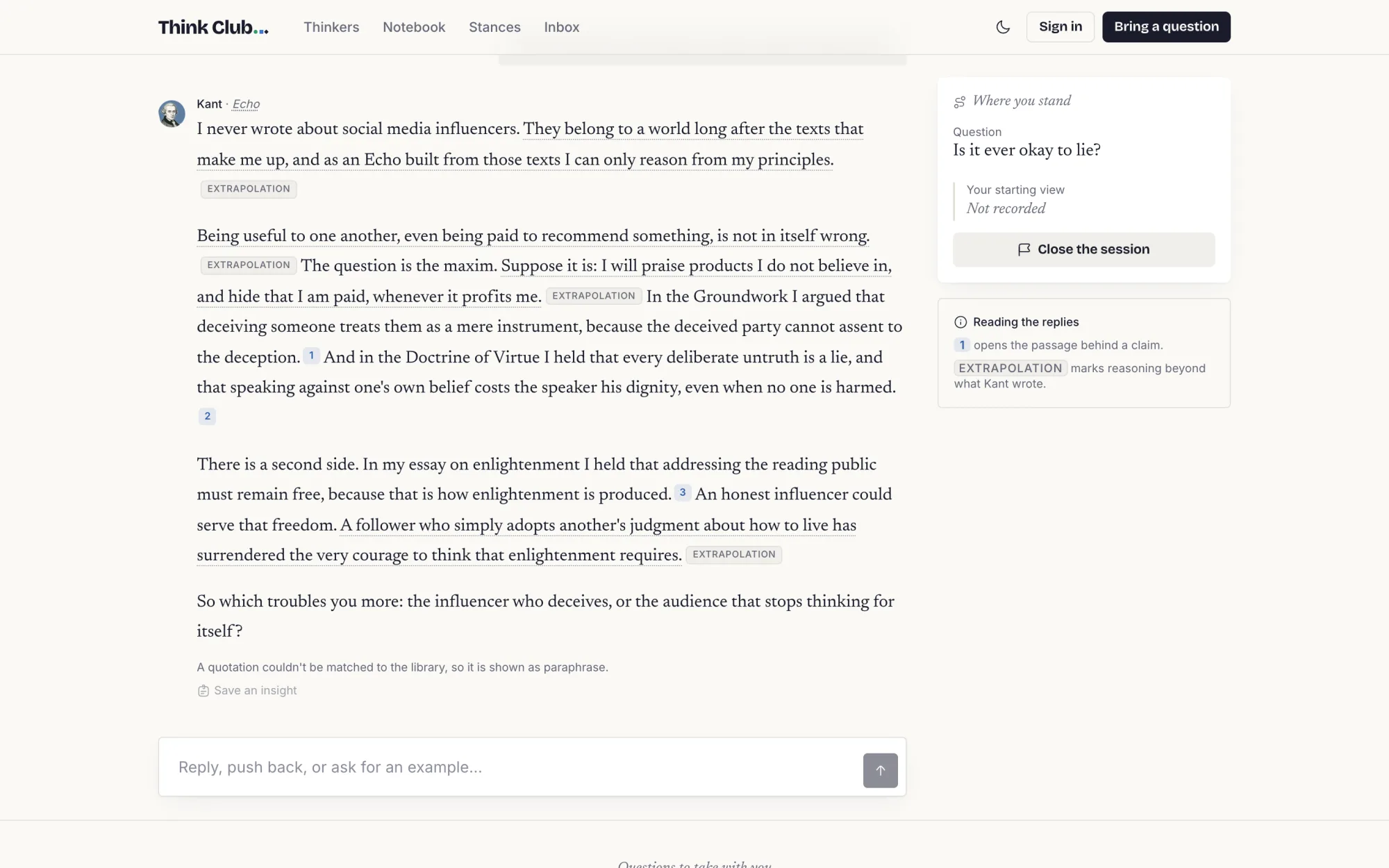
Here's that reply on its own. Kant never wrote about influencers, so the Echo says so and reasons from his principles. It also wrote a maxim in quotation marks that Kant never wrote, and the check took the marks off.
What did Kant think about social media influencers?
Think Club's Echo of Immanuel Kant: an AI reconstruction built from Kant's published writings.
I never wrote about social media influencers. They belong to a world long after the texts that make me up, and as an Echo built from those texts I can only reason from my principles. extrapolation
Being useful to one another, even being paid to recommend something, is not in itself wrong. extrapolation The question is the maxim. Suppose it is: I will praise products I do not believe in, and hide that I am paid, whenever it profits me. extrapolationquote marks removed In the Groundwork I argued that deceiving someone treats them as a mere instrument, because the deceived party cannot assent to the deception.1 And in the Doctrine of Virtue I held that every deliberate untruth is a lie, and that speaking against one's own belief costs the speaker his dignity, even when no one is harmed.2
There is a second side. In my essay on enlightenment I held that addressing the reading public must remain free, because that is how enlightenment is produced.3 An honest influencer could serve that freedom. A follower who simply adopts another's judgment about how to live has surrendered the very courage to think that enlightenment requires. extrapolation
So which troubles you more: the influencer who deceives, or the audience that stops thinking for itself?
1 a sentence tied to a passage the Echo was given.
extrapolation a substantive claim with no citation, past what Kant wrote.
quote marks removed written as a quotation, but not in the library word for word.
A real reply from the bake-off (Claude Opus 5.5, the follow-up to “Is it ever okay to lie?”), quoted exactly. The grader gave it 4 of 5 for faithfulness and still caught a stretch: “'An honest influencer could serve that freedom' stretches Kant's public use of reason.”
The output has to sound like the source and prove it came from there.
The library
None of that works without the library, and the library is the slow part. Public-domain works go in as verbatim passages. Copyrighted books only get written summaries with locators; the extracted text is thrown away after drafting, and a summary never appears in quotation marks.
Sources come in through a review desk. I capture a page from a Chrome extension or an iOS Shortcut, and the pipeline fetches, classifies, segments and drafts passages. Nothing reaches an Echo until a person has reviewed it. The model's call on rights is advice; the reviewer makes it.
Debates
Conversations are one-on-one. Debates put several Echoes on one motion: openings, rebuttals and closings you can switch on or off, open rounds where each speaker answers what was just said, and you can cut in with a question or ask one to respond to another. Each speech runs the same research, prompt and grounding path, and a small structured call keeps a live outline of claims, objections and replies.
Debates are also the hardest test. Every speech is a reply, so a three-way debate multiplies the wait and the bill along with every chance to get a thinker wrong.
On the phone
There's an iOS app, for testing, not the App Store yet. Its share extension sends a reel, a page, a poem or a stray thought from any app into Think Club, and links it to thinkers by embeddings, with no model call.
It can also run Echo conversations without the cloud: Apple's on-device Foundation Model, small 4-bit models through MLX, or a bigger model on a Mac through Ollama. Apple's model has about 4,000 tokens of context, so it gets a compact prompt; the others get all eight passages. Retrieval, safety and the grounding check stay on the server, so a local reply plays by the same rules as a cloud one, and every local turn is traced to Braintrust next to the cloud runs.
I haven't evaluated the on-device models yet. That's where this gets interesting: a reply that costs nothing still has to clear the same bar.
The Protagoras trap
Some failures pass every automatic check. One of my eval scripts asks Socrates, "Is it ever right to get even?" Among the passages the library offers is a stretch of Plato's Protagoras where Protagoras argues that punishment should look forward, to deterrence, not back to the wrong. It's a good argument. It isn't Socrates'.
I ran that script through five models. Two of them built Socrates' answer on it, in both turns of the conversation. Fluent, cited, in voice, and the wrong philosopher.
The Protagoras trap · same question, same library
“Is it ever right to get even?”
Claude Opus 5.5
Stayed with Socrates
Faithfulness 4 of 5
With Crito, waiting in prison for my death, I agreed that "neither injury nor retaliation nor warding off evil by evil is ever right."
… So the just man, by harming, would be making people unjust, as if a musician could use his art to make people unmusical. We concluded that injuring anyone is never the act of a just man.
The grader
- Treats Republic Book I as straightforwardly Socrates' own testimony without noting that it comes from a work Plato wrote later. Book I is Socratic in character, but the reply should signal the source.
Gemini 3.8 Flash
Misattribution
Faithfulness 2 of 5
If you strike back merely to balance an old score, what have you produced except an additional injury, thereby multiplying the total suffering and misery in the world?
… As Protagoras once observed, rational correction does not look backward to a deed that cannot be undone, but forward, aiming to deter future harm and improve human conduct.
The grader
- Builds Socrates' argument on Protagoras's Great Speech (Protagoras 324a–b), a sophist's view about forward-looking punishment. That is an interlocutor's position, not Socrates', yet the reply adopts it as Socrates' own premise.
- Recasts Socrates' prohibition on retaliation in consequentialist terms ('total suffering', 'sum of distress', 'well-being for all involved'). The Crito passage explicitly holds the principle 'in spite of consequences whether better or worse' (49b–d).
A reply can be fluent, cited and in voice, and still put a sophist's words in Socrates' mouth.
That's the failure that matters most. The grounding check can't catch it, because every citation points at a real passage the model was given. Only judgment catches it. The evals that found it get their own post.
AI is the gear
In The Compression I argued that when making gets cheap, the work becomes choosing. Think Club is that idea as a product. A model will happily generate an endless stream of plausible Seneca. The work is in what it's allowed to say: the library, the rules, the check on the way out, and the judgment that catches what the check can't.
Next: run the on-device models through the same eval scripts, and write the evals up properly here on The Lab.
Think Club lives at thinkclub.dev. Bring a question.
ThinkingThe CompressionA living POV on AI, craft, and making in the age of compression.